Tuesday, July 09, 2013

Pro-certainty

It's been somewhat surprising that there hasn't been more overt interest of American pro-lifers in the Irish government's legislation to allow abortion under highly limited circumstances. But here's William Saunders from Americans United For Life having attended the weekend's pro-life (and anti-legislation) rally in Dublin, writing in National Review's The Corner --

This bill is supposedly “required” by the European Court of Human Rights’s decision in ABC vs. Ireland two years ago. The lead party in the government, Fine Gael, campaigned in the last election on a promise not to legalize abortion. It is abandoning that commitment now, and the Irish people are expressing their outrage ...  Will the Irish politicians allow the Irish people to decide the abortion issue, or will they bow to the European Court of Human Rights?

It's a very constricted view to begin Ireland's abortion narrative with a 2010 ECHR decision. Instead it goes back -- as Irish people painfully recall -- to an ill-advised "pro-life" amendment to the Irish constitution which ended up being interpreted by Irish -- not European -- courts as creating a limited right to abortion under certain medical and psychological circumstances. But no enabling legislation was ever passed on foot of these decisions, until embarrassments (like the ECHR decision) and tragedies (like the Savita case) induced the current government to meaningful action. Its objective is to ensure that people understand what the applicable law is, not to open the door to "social abortion" as former Taoiseach Bertie Ahern bizarrely called it.

The attitude that Saunders displays risks replicating the outcome of the tactics of Ireland's more unreasonable pro-life activists, whose antics over this law are alienating many in what is still an anti-abortion culture by western European or American standards.

Friday, July 05, 2013

The rise and fall of the Arab Bobo

David Brooks New York Times column in March 2011, working off Samuel Huntington's The Clash of Civilizations at the onset of the Arab Spring --

In retrospect, I’d say that Huntington committed the Fundamental Attribution Error. That is, he ascribed to traits qualities that are actually determined by context. He argued that people in Arab lands are intrinsically not nationalistic. He argued that they do not hunger for pluralism and democracy in the way these things are understood in the West. But it now appears as though they were simply living in circumstances that did not allow that patriotism or those spiritual hungers to come to the surface. ... Over the past weeks, we’ve seen Arab people ferociously attached to their national identities. We’ve seen them willing to risk their lives for pluralism, openness and democracy. I’d say Huntington was also wrong in the way he defined culture ... But it seems clear that many people in Arab nations do share a universal hunger for liberty. They feel the presence of universal human rights and feel insulted when they are not accorded them. Culture is important, but underneath cultural differences there are these universal aspirations for dignity, for political systems that listen to, respond to and respect the will of the people.

David Brooks, New York Times column today, in the wake of the Egyptian military coup --

It’s not that Egypt doesn’t have a recipe for a democratic transition. It seems to lack even the basic mental ingredients.

Incidentally, in another segment of the same column, he says

It’s no use lamenting Morsi’s bungling because incompetence is built into the intellectual DNA of radical Islam. We’ve seen that in Algeria, Iran, Palestine and Egypt: real-world, practical ineptitude that leads to the implosion of the governing apparatus.

He should go across the page to read Shadi Hamid on what actually happened in Algeria. "Radical Islam" never got a chance to govern because the generals blocked them from doing so after an election they'd won. The rest is a brutal civil war and a terrorist group that had developed the idea of hijacking a plane and flying it into the Eiffel tower. Well before 9/11. Aren't smart conservatives supposed to have "unintended consequences" as a reflex?

UPDATE: The list of other countries that Brooks gives is pretty shaky in terms of his narrative too. And a lengthier window on his columns shows that the anti-Huntington column was the outlier.

Thursday, July 04, 2013

Now that's a military-industrial complex

White House statement on the Egyptian political, er, transition --

The United States continues to believe firmly that the best foundation for lasting stability in Egypt is a democratic political order with participation from all sides and all political parties —secular and religious, civilian and military.

Is there any country other than Egypt where "all sides" is taken to include the military?

Don't let the door hit you on the way out

Just in case Bolivian President Evo Morales was wondering how quickly things can turn on you despite all the smiles of an official visit, he should contemplate former Egyptian President Mohammed Morsi. Here he is meeting Saudi King Abdullah in Jeddah around this time last year. Here's part of tonight's statement from King Abdullah on his departure from office --

At the same time, we strongly shake hands with the men of all the armed forces, represented by General Abdulfattah Al-Sisi, who managed to save Egypt at this critical moment from a dark tunnel God only could apprehend its dimensions and repercussions, but the wisdom and moderation came out of those men to preserve the rights of all parties in the political process.

Wednesday, July 03, 2013

Know nothing securocrats

Thanks to billions spent on covert surveillance, the US government can probably tell you what every ambassador to Washington had for breakfast. But when tumultuous geopolitical developments unfold, as in Egypt, there doesn't appear to be a much of a plan other than "Watch CNN."

The value of the state visit photo-op

The all-smiles Paris meeting of French President Francois Hollande with Bolivian President Evo Morales in March wasn't enough to ensure that Morales' official plane could get through French airspace yesterday, on account of an apparently unfounded suspicion that Edward Snowden was on it.

Forcing planes, especially small ones, to divert after they've taken off is dangerous.

Photo: Elysee Palace.

Monday, July 01, 2013

That's a polite way to put it

Irish Central Bank governor Patrick Honohan in an interview with the German newspaper Frankfurter Allgemeine Zeitung (FAZ) [related story] --

FAZ: Why should German politicians and others in Europe believe that things have really changed in Ireland over the last few years? 

PH: Well I think they do. They see the extensive changes in personnel and those who interact with Irish officials and policymakers do see how….I think the hubris of the past has definitely gone.

Saturday, June 29, 2013

Horse, meet stable door

So far in the Irish Independent's Anglo Irish tapes, the bank's former CEO David Drumm is emerging as a classic villain. But maybe the villains get the best lines. Here he is in the latest tape release [Clip 11(a) "Punch"], recounting one of his December 2008 meetings with the Department of Finance concerning how to raise capital for the bank in which the department was telling him what he had to do once he had gotten some outside investor interest --

and then when you come back, we've got a long process to go through to sort of approve you for capital, including due diligence --  which is insulting to the intelligence because they've guaranteed all our liabilities

Which is exactly right. Why was the government asking a bank to wait for due diligence when they'd already given it a full guarantee? The due diligence is done by the entity before putting the big money on the table, which they already had in September. Unless ... they hadn't!

UPDATE: Much of the initial commentary on this tape focuses on a supposed threat by Drumm to punch Brian Lenihan, then Minister of Finance. It's clear that Drumm meant it metaphorically as a demand to Lenihan to clarify whether or not Anglo was considered systemic by the government. Incidentally, Lenihan was not diagnosed with cancer till a year after this conversation, contrary to some tweets related to the topic this evening.

FINAL UPDATE: In a related clip "pregnant", Drumm unintentionally writes the epitaph for the guarantee --

When you've guaranteed somebody's entire liabilities, it's smart to write a very small cheque to stop them being called.

Note: here's a transcript of the full conversation involving both clips above.

Thursday, June 27, 2013

It's like confusing Austrian with Australian

Veteran Irish economics pundit David McWilliams -- an apparent influence on the country's disastrous bank guarantee -- writes in today's Irish Independent (alt. link) in the light of the newspaper's latest disclosures about the behaviour of Anglo Irish Bank in the run-up to the guarantee:

THE brilliant English economist John Stuart Mill, writing in the 1860s, noted that "a crash doesn't destroy wealth, it merely reflects the extent to which wealth has already been destroyed by stupid investments made during the preceding boom".

With a modicum of knowledge about 19th century economics, the bogus quote detector should be going off. Those words don't sound like John Stuart Mill, they sound at best like a modern paraphrase of something he might have said. One's curiosity is further piqued when Google can't find the quote (it can find 2 other instances of McWilliams using the same quote). So then you go with the possibility that it's a paraphrase, and VoilĂ , the quote appears:

Panics do not destroy capital; they merely reveal the extent to which it has been destroyed by its betrayal into hopelessly unproductive works.

But that's not the only problem. That quote is not from John Stuart Mill, though various websites (from where McWilliams probably took his notes) say that it is. It was by John Mills, Article read before the Manchester Statistical Society, December 11, 1867, on Credit Cycles and the Origin of Commercial Panics, which is an important article in the intellectual ancestry of Austrian economics.

Luckily, Ireland's actual policy decisions around the time of its banking crisis were characterized by much greater diligence.

UPDATE 27 SEPTEMBER: McWilliams uses the botched quote again.

Designing the next banking crisis

The European Union Council of finance ministers was popping the Champagne last night as they reached agreement to implement a 2008 decision to beef up their authorities to wind up busted banks. In theory the deal creates large room for bail-in i.e. support from existing creditors before taxpayers have to pick up the tab. But the various thresholds which the deal imposes for these bail-ins to apply are small, and riddled with exceptions e.g.

Certain types of liabilities would be permanently excluded from bail-in: – covered deposits; – secured liabilities including covered bonds; – liabilities to employees of failing institutions, such as fixed salary and pension benefits; – commercial claims relating to goods and services critical for the daily functioning of the institution; – liabilities arising from a participation in payment systems which have a remaining maturity of less than seven days; – inter-bank liabilities with an original maturity of less than seven days.

This invites the EU's next Anglo Irish to (1) go deep, load up on such dodgy loans that you'll quickly bust through any bail-in thresholds, (2) pay your reckless managers large salaries and pensions, which are protected from bail-in, and (3) finance yourself as much possible through the payments system, especially when things are about to go pear-shaped., because payment system transactions and short-term liabilities are also protected from bail-in.

At some point, we're at the "it's not a bug, it's a feature" conclusion.

UPDATE 9 JULY: Credit where it's due, Jörg Asmussen, ECB Board member lists the ECB complaints about the above in a speech in London --

Second, the arrangements for bail-in could be more rules-based. The ECB has always argued for discretionary exclusions from bail-in to be limited so as to make the rules of the game clear for global investors. The Council approach gives the resolution authority powers to discretionarily exclude any type of liability for reasons of impossibility within a certain time frame, or to avoid wide-spread contagion. In our view, there would have been a benefit in defining ex ante the categories of liabilities that could have been excluded. This means that investors will lack certainty about how the new framework will be used, and in my view it may slow down the process of reducing financial fragmentation. For instance, there will inevitably be a political economy dimension to how national resolution authorities decide to exercise their discretion, with creditor classes that have particular importance in different national contexts likely to be favoured. This will affect the level-playing field between Member States. Moreover, the BRRD foresees that after 8% of a bank’s liabilities have been bailed-in, the national resolution authority has the option to use its resolution fund to bail-out a further 5% of the bank’s liabilities. However, some countries will have larger resolution funds than others, for instance if they have more banks paying into the fund. This means that these countries would be able to bail-out more domestic banks before they exhaust the fund than those with less resolution resources available, who would need to use more bail-in. This will also not help reduce fragmentation.

Monday, June 24, 2013

It works both ways

From the Irish Independent's Anglo tapes --

He [Bowe] also says: "If they (Central Bank) saw the enormity of it up front, they might decide they have a choice. You know what I mean? "They might say the cost to the taxpayer is too high . . . if it doesn't look too big at the outset . . . if it looks big, big enough to be important, but not too big that it kind of spoils everything, then, then I think you have a chance. So I think it can creep up." Mr Fitzgerald, the Director of Retail Banking, is heard saying: "Yeah. They've got skin in the game and that is the key."

Nassim Taleb --

Rule 5: Decision makers must have skin in the game. At no time in the history of humankind have more positions of power been assigned to people who don't take personal risks. But the idea of incentive in capitalism demands some comparable form of disincentive. In the business world, the solution is simple: Bonuses that go to managers whose firms subsequently fail should be clawed back, and there should be additional financial penalties for those who hide risks under the rug. This has an excellent precedent in the practices of the ancients. The Romans forced engineers to sleep under a bridge once it was completed.

The problem is that "skin in the game" logic quickly leads to the sunk cost fallacy -- we've already put in money, so we have to put in more -- and that's what Anglo banked on in its dealings with the Irish government.

Saturday, June 22, 2013

The upwardly mobile are revolting

Financial Times analysis of the Brazil protests --

“These people view their ascension as the exclusive product of their own hard work. They are not conscious it is the fruit of policies taken by the government as well,” says Rui FalcĂŁo, president of the PT (governing Workers Party).

VocĂŞ nĂŁo construir isso.

Spend your dye-stained euros in Cyprus

For reasons of legal technicalities, the government of Belgium has to get European Central Bank (ECB) approval for new regulations which require currency handlers in Belgium to take out of circulation euros that look like there were stained by counter-theft measures now used in most large shipments of cash. The problem is that such notes are still legal tender. So some legal gymnastics ensues --

Nevertheless, the ECB notes that neutralised euro banknotes retain their legal tender status and that this has been acknowledged by the European Commission. In this respect, the requirements and prohibitions introduced in the draft law by the amendments would affect the legal tender status of presumably neutralised banknotes. In addition, they would effectively introduce limitations on cash payments in relation to the settlement of cash transactions where such euro banknotes are used in good faith to this end. 

Recital 19 of Council Regulation (EC) No 974/98 of 3 May 1998 on the introduction of the euro 12 states that limitations on payments in notes and coins, established by Member States for public reasons, are not incompatible with the status of legal tender of euro banknotes and coins, provided that other lawful means for the settlement of monetary debts are available. The ECB acknowledges that: (a) such other lawful means for the settlement of monetary debts, other than neutralised euro banknotes, are available in Belgium; and (b) the draft law’s objective of enhancing public security by reducing the risk of criminals’ being able to put into circulation neutralised euro banknotes in relation to a crime qualifies as a public reason outweighing the impact of the limitations on cash payments.

One strange thing is that while the ECB legal department bends over backwards to ensure that cash that might have been involved in a robbery remains legal tender in Belgium, Cyprus still has significant currency controls -- technically on the banking system rather than on cash, but in a modern economy, you can't have one without the other. Given the ECB's logic in the Belgium case, does this mean that it would be harder for Cyprus to bring in restrictions on the use of dodgy-looking euro cash since alternative forms of payment are more difficult?

Friday, June 21, 2013

Moving with the times

Judging from the e-mail traffic around here, it looks like Ireland has found a new business line from being a preferred offshore location for structured investment vehicles of the global banking system, an activity that blew up in 2007. Now we seem to be a preferred offshore site for spam. Litigation being what it is in Ireland -- what did the EU expect when taking on the country's most powerful lobby? -- we won't name names, but a recent spam surge began with an outfit nominally complying with US law by giving a physical address on Baggot Street in Dublin.

Monday, June 17, 2013

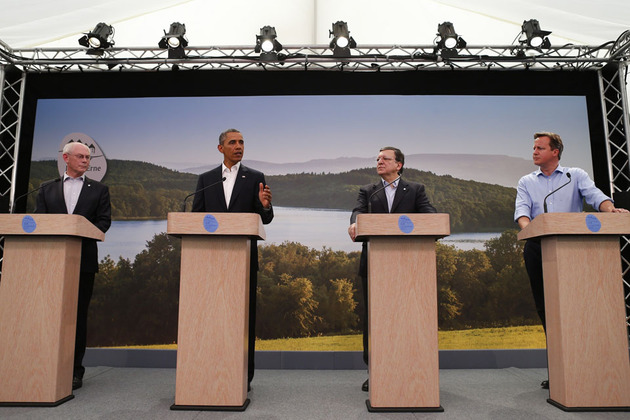
Not even a dreary spire

Did the UK really bring the G8 leaders to Lough Erne just to have a fake backdrop at the news conferences?

Saturday, June 15, 2013

Aleppo Open

A Free Syrian Army fighter wears a stylish Titleist cap as the group waits for the next go-round in Aleppo with Bashar al-Assad's Russian-equipped and Hezbollah-augmented forces.

Photo: Reuters stringer, although the same photo appears in the New York Times print version only of this story, credited to Hamid Khatib.

Thursday, June 13, 2013

Offer not applicable in Syria

This is a Russian tank patrolling Grozny, Chechnya, in the year 2000, after the Russians were done demolishing the city with artillery and rockets to force Chechen rebels out of it.

Bashar al-Assad -- with Russian-trained military advisers and Russian military equipment -- has done the same thing on a small scale in Qusayr last week and is intending to the same thing to Aleppo, a rather large city. He'll probably do it in July, when the world's foreign policy elites are en vacances and the best we can hope for is a statement of condemnation tapped out on someone's Blackberry.

Don't we say Never Again after each one of these things? Heckuva job.

No Irish need apply

United Kingdom Independence Party (UKIP) leader Nigel Farage opening sentence in the Wall Street Journal --

Speaking in Essex on Monday ahead of next week's G-8 summit in Belfast, British Prime Minister David Cameron ..

The G-8 summit is not in Belfast. It's at the Lough Erne resort in County Fermanagh, which is about 90 miles from Belfast. You'd think a party that is so focused on the intrinsic brilliance of the UK would have respect for such distinctions.

Unless they're not sure whether Northern Ireland is in the UK.

G-8 summitteers, welcome to Ireland.

Monday, June 10, 2013

The consultant-industrial complex

The Wall Street Journal has been doing good reporting on the not-so-paradoxical Washington DC property market, the one that kept booming even as other markets slumped. The reason: government spending on consultants and contractors, which has fed private fortunes in the defence and intelligence businesses. Now with the Prism/Edward Snowden revelations, the government is finding out that the supposed efficiency of contracting doesn't even bring information security, whatever its (dubious) financial benefits. Also, we've been saying it for about 9 years, but there's already a word out there for the people on the government side of these transactions: Securocrats.

Saturday, June 08, 2013

The kid that keeps the marriage together

New York Times on the Troika falling-out --

Only in Ireland have the troika’s policies, anchored in budget cuts and tax increases, shown much sign of working. 

Image: Amazon page for Terry Eagleton's The Truth About the Irish.

Friday, June 07, 2013

Less stubborn than the EU

Saudi Press Agency reporting (with as much relish as can be communicated in a Saudi Press Agency report) the volte-face of Sheikh Yusuf Qaradawi, long-time rhetorical bĂŞte noire of the global war on terror --

The Grand Mufti of the Kingdom of Saudi Arabia Sheikh Abdulaziz Al Al-Sheikh, who is also President of the Council of Senior Scholars, Scholarly Research and Ifta; Sheikh Saleh bin Abdulaziz Al Al-Sheikh, the Minister of Islamic Affairs, Endowments, Call and Guidance; and Dr. Mohammed bin Abdulkarim Al-Essa, the Minister of Justice, thanked Sheikh Dr. Yusuf Al-Qaradawi, President of the World Union of Muslim Scholars, who is based in Egypt, on his speech recently regarding the flagrant aggression against the Syrian people by Hezbollah of Lebanon in cooperation with the Syrian regime. They also hailed the position of Qaradawi in support of the Kingdom of Saudi Arabia's senior scholars, which was clear regarding this sectarian party since its inception. Qaradawi said he was earlier at odds with Saudi scholars on their views towards Hezbollah. 'Now I realized, they were right and I am wrong', he was quoted as saying.

Tuesday, June 04, 2013

We've still got it

Ireland's financial centre business moves with the times --

ReutersEgypt this month announced a $12 billion bond programme that will include sukuk issuance in early 2014, which would be Irish-listed and governed under English law.

World Peace

Nigel Powers (from Goldmember) --

There's only two things I hate in this world. People who are intolerant of other people's cultures and the Dutch.

Istanbul resident quoted in New York Times analysis of the Turkish protest crisis --

Ms. Pacal said she and her friends believed that secular Turks were prejudiced against the pious. “What I can’t stand is people who are against us for our religion,” she said.

Monday, June 03, 2013

Potemkin village

That's a fake shopfront behind this man and his dog in Belcoo, County Fermanagh -- near where, not by coincidence, the G8 summit will be held later this month. Great* story with photography by Cathal McNaughtan for Reuters.

UPDATE: A widely circulated Calculated Risk post based on an earlier Irish Times story about the same phenomenon appears to convey that Fermanagh is in the Republic. *The Irish Times probably should have gotten a credit from Reuters.

Sunday, June 02, 2013

Bottom of the heap

Atrios --

The culture clash in NYC over bikes is pretty amusing, though I really don't get why they drive some people so insane. More than that, I really don't understand longtime New Yorkers (and I mean people in the dense transit and taxi rich bits, mostly Manhattan and parts of Brooklyn), choose to have personal car-centric lives. 

One difference between those dense bits of Manhattan and Brooklyn relative to the corresponding parts of Paris and London -- from which the bike rental idea was imported -- is that way more actual city residents are in those places, whereas they've been priced out in the European metropolises. Thus the routines of daily life in a congested city -- needing to get to 5 different places to complete what would be a single errand in the suburbs -- have a lot more weight in how people think about transport in New York. And rental bikes don't help a lot with that, so the locals are not going to be especially excited about them.

Saturday, June 01, 2013

It's an ill wind

Reuters report that Cyprus has withdrawn citizenship given to Assad crony Rami Makhlouf --

Makhlouf initially petitioned Cyprus for citizenship in 2009, Phileleftheros reported. His supporting documents included real estate valued at 320,000 euros on the island, and 17.3 million euros in fixed five-year time deposits in Cypriot banks, it said.

Assuming the money was still there recently, that means he took a big hit from the 40 percent haircut on bank deposits in the Cyprus bailout.

Friday, May 31, 2013

Cranky Friday

These should probably be Tweets but anyway.

1. Do we really want to be celebrating (New York Times) young teens celebrating Daft Punk/Pharrell/Nile Rodgers Get Lucky given what those lyrics are actually about? Or  do we discount that as being only in New York?

2. What's the point of the International Criminal Court*(New York Times)? Bashar al-Assad must be laughing his moustache off at the threat that he might end up there.

3. Washington Post: "Liberal hawks are silent on Syria." Have any liberals, hawks or otherwise, had anything to say on Syria? You wouldn't know it from the liberal blogs.

*In fairness to the ICC, the botched verdicts in this case are from the International Criminal Tribunal for the Former Yugoslavia.

Intellectual Property

Wall Street Journal op-ed piece by John Bruton and Kevin Murphy --

The Organization for Economic Co-operation and Development doesn't regard Ireland as a tax haven. The OECD identifies four key indicators of a tax haven and none of them applies to Ireland. The first indicator is having no taxes or only nominal taxes; the second is a lack of transparency; the third is an unwillingness to exchange information with tax administrators of OECD countries; and the fourth is an absence of a substantial activity requirement. None of these criteria describes Ireland ...In December 2012, Ireland became one of the first countries in the world to sign an agreement with the U.S. to improve international tax compliance and to implement the Foreign Account Tax Compliance Act. This type of agreement is now being hailed as the emerging international standard for the automatic exchange of tax information between countries.

Irish Times op-ed by Joanne Richardson --

The OECD identifies four key indicators of a tax haven. They are: having no taxes or only nominal taxes; a lack of transparency; an unwillingness to exchange information with tax administrations of OECD member countries; and the absence of a substantial activity requirement. None of these criteria applies to Ireland. Furthermore, in December 2012, Ireland became one of the first countries in the world to sign an agreement with the United States to improve international tax compliance and implement Fatca (Foreign Account Tax Compliance Act). This type of agreement is now being hailed as the emerging international standard for the automatic exchange of tax information.

Now in fairness the rest of the articles have fairly different content, and the point about FATCA is a good one given that FATCA faced a well organized media campaign against it in the US and Europe before European governments realized its potential in their own assault on tax evasion by their citizens.

But, the similarities above point to the obvious: there are talking points circulating, prepared by vested interests in the current Irish corporate tax system, and finding their way into opinion pages of newspapers.

Not necessarily good or bad. Something to be aware of.

Saturday, May 25, 2013

Where does hype go to die?

This week --

The Manchester City-Yankees partnership, which will no doubt antagonize the Mets, will deepen existing ties because the Yankees’ stadium concessions business, Legends Hospitality, already provides services at Manchester City’s home ground, Etihad Stadium. Manchester City, the recently deposed champion of England’s Premier League, will play an exhibition match against another British powerhouse, Chelsea, on Saturday at Yankee Stadium, and city and M.L.S. officials were eager to announce a deal before that game. “In the Yankees, we have found the absolute best partner for developing a world-class sports organization and a winning team that will carry the New York City Football Club name with pride,” said Ferran Soriano, the chief executive of Manchester City.

February 2001 --

Manchester United have consolidated their position as the richest football club in the world by joining forces with American baseball giants New York Yankees. The biggest joint-marketing deal in the history of sport, potentially worth billions of pounds, was unveiled at a press conference in Manhattan on Wednesday ... Under the deal, David Beckham and Fabien Barthez will be paraded at the Yankee Stadium, with El Duque and outfielder Bernie Williams visiting Old Trafford.

Thursday, May 23, 2013

Transnational elites

Quality Woolwich-related trolling from Glenn Greenwald in the Guardian --

On Twitter last night, Michael Moore sardonically summarized western reaction to the London killing this way: I am outraged that we can't kill people in other counties without them trying to kill us!" Basic human nature simply does not allow you to cheer on your government as it carries out massive violence in multiple countries around the world and then have you be completely immune from having that violence returned.

What US military violence in Chechnya or British military violence in Nigeria was being "returned" by US permanent resident Tamerlan Tsarnaev in Boston or the two (apparently) British machete-wielders in London?