This Bahrain news agency story is responding to what it says is a Washington Post story when it's actually a Washington Times story.
Thursday, August 18, 2011
He Yadda Yaddad the worst part
Matt Yglesias has a strange post about monetary policy in Nazi Germany. It plays off the again topical issue of FDR's monetary policy in the New Deal era but the reader is left with the distinct impression that the story of 1930s German economic policy is two monetary wheezes (a parallel currency and then gold seizures in Austria and Czechoslovakia) from which it was just a hop, skip, and jump to the war effort finally getting the economy to full employment.
But what's strange is to propound so authoritatively about Nazi economic policy and never mention fiscal policy, which is where all the action was. Here's a review by Alex Harrowell of Adam Tooze's excellent book on the topic that lays it all out: monetary policy didn't have a whole lot to do with Germany's 1930s "boom" which was in fact a ruthless military-industrial buildup financed by suppression of consumption and propaganda-boosted labor supply. Monetary policy was just the increasingly desperate leak-plugging operation on the side, as Nazi economic lunacy ran into the mundane problems of all economic lunacy -- shortages and repressed inflation, not least of foreign currency. Only in Rick Perry's fantasy world does this tell us anything about the American policy dilemmas today.
UPDATE 13 SEPTEMBER: Yglesias returns to the topic:
In broader terms, the policies of Adolf Hitler were far inferior to those of his predecessors in Germany. But the Nazi regime, under the leadership of Hjalmar Schacht, implemented highly effective monetary policies ...
But what's strange is to propound so authoritatively about Nazi economic policy and never mention fiscal policy, which is where all the action was. Here's a review by Alex Harrowell of Adam Tooze's excellent book on the topic that lays it all out: monetary policy didn't have a whole lot to do with Germany's 1930s "boom" which was in fact a ruthless military-industrial buildup financed by suppression of consumption and propaganda-boosted labor supply. Monetary policy was just the increasingly desperate leak-plugging operation on the side, as Nazi economic lunacy ran into the mundane problems of all economic lunacy -- shortages and repressed inflation, not least of foreign currency. Only in Rick Perry's fantasy world does this tell us anything about the American policy dilemmas today.
UPDATE 13 SEPTEMBER: Yglesias returns to the topic:
In broader terms, the policies of Adolf Hitler were far inferior to those of his predecessors in Germany. But the Nazi regime, under the leadership of Hjalmar Schacht, implemented highly effective monetary policies ...
Sunday, August 14, 2011
Note to editors
If, after every occurrence of the country name "Bahrain" we have to have "home to America's Fifth Fleet", can we also have for "Syria" something like "home for 40 years to a USSR/Russia naval base?" Incidentally, Syria (unlike Bahrain) is using its own naval facilities to shell dissident areas, so keeping track of these naval assets is important.
Saturday, August 13, 2011
Agent Bush: Mission Accomplished
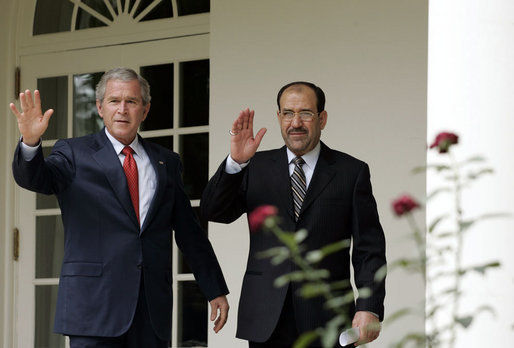
BAGHDAD — As leaders in the Arab world and other countries condemn President Bashar al-Assad’s violent crackdown on demonstrators in Syria, Prime Minister Nuri Kamal al-Maliki of Iraq has struck a far friendlier tone, urging the protesters not to “sabotage” the state and hosting an official Syrian delegation. Mr. Maliki’s support for Mr. Assad has illustrated how much Iraq’s position in the Middle East has shifted toward an axis led by Iran.
Photo (Paul Morse): July 2006 White House meeting between Maliki and George Bush.
Thursday, August 11, 2011
Pop Culture Crossover
Daily Star of Lebanon
Lebanese Forces leader Samir Geagea has described Progressive Socialist Party leader Walid Jumblatt as the American television sitcom character Sergeant Schultz.
Sunday, August 07, 2011
And anyone can go to Dubai

A well-designed building in Jeddah could enhance the visits of the millions of pilgrims who pass through it each year on their way to Mecca. On the other hand, a badly designed building could make a pilgrimage to Mecca feel more like a shopping weekend in Dubai.
Above, the garish Big Ben imitation overlooking the central courtyard in Mecca. The complex includes a massive mall, hotels, and luxury apartments.
Photo: Salah Malkawi for the New York Times.
Cause and effect
Wall Street Journal article on another European policy elite summer --
"If you didn't allow vacations during crises, [EU leaders] would not have had a vacation in the last three years," said Kim Oosterlinck of the Solvay Brussels School of Economics and Management.
"If you didn't allow vacations during crises, [EU leaders] would not have had a vacation in the last three years," said Kim Oosterlinck of the Solvay Brussels School of Economics and Management.
Thursday, August 04, 2011
Crisis, what crisis? Oh, that one. Right.
European Commission President Jose Manuel Barroso, statement following the Eurozone-rescuing summit of 21 July --
So, ladies and gentlemen, we needed a credible package: we have a credible package. It deals with both the concerns of the markets and of citizens. It responds also to the concerns of all Member States of the Euro area. It is a package that every government has signed up to. For the first time in the crisis, the politics and the markets are coming together.
Jose Manuel Barroso, letter to EU heads of government 3 August --
The 21st of July bold decisions on the Greek package and the increased flexibility of the EFSF (precautionary use, recapitalisation of banks and intervention in secondary bond markets), are not having their intended effect on the markets. Markets highlight, among other reasons, the global economic uncertainties due to both economic growth and the protracted decision on budgetary adjustments in the US but, first and foremost, the undisciplined communication and the complexity and incompleteness of the 21st July package.
Incidentally, for someone complaining about communications problems, his press statement of August 3 is notably less bleak than the letter he was writing at the same time and which was made public today and from which the above passage is taken.
Wednesday, August 03, 2011
It's better than Arab cottage cheese
Over the last couple of years, there was a vibrant cottage industry among American conservatives in travelling to Israel and proclaiming the discovery of a new economic miracle in the land of milk and honey. The canonical texts -- which launched a thousand op-ed pieces -- are Startup Nation by Dan Senor and Saul Singer and The Israel Test by George Gilder.
To the extent that these books had any economic methodology -- as opposed to an implicit Up Yours to Israel's immediate neighbours -- it involved talking to a highly selected sample of successful export-oriented rich people in Israel and using these venture capital-dependent cases to draw conclusions about the overall success of Israel's economy.
Minor issues such as the validity of comparing Israel to clapped out dictatorships and petro-states as opposed to small European states (a peer group that Israel itself seeks) can be set aside. Because it turns out that Israel's American boosters missed the story. The story being that actual Israelis were growing ever more frustrated with the basic cost of living, complaints now exemplified in the tale of the over-expensive cottage cheese and the vested interests that lie behind it. Here's an excellent article from another of those actual Israelis that explains the economics of the problem. The neocon view of Bibi Netanyahu as a combination of Churchill and Thatcher on the Jordan looks a bit rougher against this backdrop (not to mention Bibi about to quietly follow Barack Obama's once outrageous 1967 peace line principles of a few weeks ago).
In the spirit of seeking general principles where there might not be any, the lesson appears to be that when The National Question dominates domestic political debate, it leaves huge room for economic mischief. That's a problem we know in Ireland.
To the extent that these books had any economic methodology -- as opposed to an implicit Up Yours to Israel's immediate neighbours -- it involved talking to a highly selected sample of successful export-oriented rich people in Israel and using these venture capital-dependent cases to draw conclusions about the overall success of Israel's economy.
Minor issues such as the validity of comparing Israel to clapped out dictatorships and petro-states as opposed to small European states (a peer group that Israel itself seeks) can be set aside. Because it turns out that Israel's American boosters missed the story. The story being that actual Israelis were growing ever more frustrated with the basic cost of living, complaints now exemplified in the tale of the over-expensive cottage cheese and the vested interests that lie behind it. Here's an excellent article from another of those actual Israelis that explains the economics of the problem. The neocon view of Bibi Netanyahu as a combination of Churchill and Thatcher on the Jordan looks a bit rougher against this backdrop (not to mention Bibi about to quietly follow Barack Obama's once outrageous 1967 peace line principles of a few weeks ago).
In the spirit of seeking general principles where there might not be any, the lesson appears to be that when The National Question dominates domestic political debate, it leaves huge room for economic mischief. That's a problem we know in Ireland.
Tuesday, August 02, 2011
What could possibly have gone wrong?

Above (via European Council photo service), Council President Herman van Rompuy and Commission President (since the Bertie Ahern-brokered deal that put him there in 2004) Jose Manuel Barroso initiate the Eurocrat orgy of self-congratulation following the July summit that kept Greece on the official financing morphine until the next spasm and so saved all of the Eurozone from contagion. We were told.
Today --
Italian authorities will meet on Tuesday to discuss growing market turmoil that has sent borrowing costs spiraling to dangerous levels and threatened to drag Italy into full-scale crisis.
Friday, July 29, 2011
Pet goats are calm
A Reuters story excitedly previews a George W. Bush interview with the National Geographic channel that will air in August --
In a rare interview with the National Geographic Channel, Bush reflects on what was going through his mind at the most dramatic moment of his presidency when he was informed that a second passenger jet had hit New York's World Trade Center ... Bush said he could see the news media at the back of the classroom getting the news on their own cellphones "and it was like watching a silent movie."
Bush said he quickly realized that a lot of people beyond the classroom would be watching for his reaction. "So I made the decision not to jump up immediately and leave the classroom. I didn't want to rattle the kids. I wanted to project a sense of calm," he said of his decision to remain seated and silent.
"I had been in enough crises to know that the first thing a leader has to do is to project calm," he added.
Page 38 of the 9/11 Commission Report of 2004 --
The President told us his instinct was to project calm, not to have the country see an excited reaction at a moment of crisis. The press was standing behind the children; he saw their phones and pagers starting to ring. The President felt he should project strength and calm until he could better understand what was happening.
What we learn therefore is that Bush has memorized the explanation that he and his handlers came up with for how the Decider-in-Chief froze on 9/11, not some new insights into his thinking on that disastrous day.
In a rare interview with the National Geographic Channel, Bush reflects on what was going through his mind at the most dramatic moment of his presidency when he was informed that a second passenger jet had hit New York's World Trade Center ... Bush said he could see the news media at the back of the classroom getting the news on their own cellphones "and it was like watching a silent movie."
Bush said he quickly realized that a lot of people beyond the classroom would be watching for his reaction. "So I made the decision not to jump up immediately and leave the classroom. I didn't want to rattle the kids. I wanted to project a sense of calm," he said of his decision to remain seated and silent.
"I had been in enough crises to know that the first thing a leader has to do is to project calm," he added.
Page 38 of the 9/11 Commission Report of 2004 --
The President told us his instinct was to project calm, not to have the country see an excited reaction at a moment of crisis. The press was standing behind the children; he saw their phones and pagers starting to ring. The President felt he should project strength and calm until he could better understand what was happening.
What we learn therefore is that Bush has memorized the explanation that he and his handlers came up with for how the Decider-in-Chief froze on 9/11, not some new insights into his thinking on that disastrous day.
Thursday, July 28, 2011
Karl Rove condemns rising income inequality in America
Well, not exactly. But he seems to be noticing its consequences, if not the link. In his regular Thursday perch at the Wall Street Journal, he laments the closing of Furin's restaurant in Georgetown--
The family diner, a D.C. landmark, featured wafer-thin pancakes, great sandwiches, homemade soups and the capital's best cakes and cupcakes. It drew generations of students, social types, power brokers and travelers wealthy enough to stay at the Four Seasons across the street but savvy enough to know where to get a wonderful breakfast.
Note: the expensive Four Seasons across the street isn't closing. Business better for the places getting more money from the wealthy customers. Weird, that. The post mortem --
No small business ends for just one reason. But with fewer conventions coming to Washington, a slow economy and people dining out less, it got gradually tougher to keep Furin's doors open
Finally, note the man who was as good as the "real Americans versus Washington" rhetoric as anybody wander all of 14 blocks from his old White House job to find an anecdote for a tough economy.
The family diner, a D.C. landmark, featured wafer-thin pancakes, great sandwiches, homemade soups and the capital's best cakes and cupcakes. It drew generations of students, social types, power brokers and travelers wealthy enough to stay at the Four Seasons across the street but savvy enough to know where to get a wonderful breakfast.
Note: the expensive Four Seasons across the street isn't closing. Business better for the places getting more money from the wealthy customers. Weird, that. The post mortem --
No small business ends for just one reason. But with fewer conventions coming to Washington, a slow economy and people dining out less, it got gradually tougher to keep Furin's doors open
If things are this bad for a small Washington DC business with the existing level of public spending cuts, how much worse would they be if Rove got the cuts that he wanted?
Finally, note the man who was as good as the "real Americans versus Washington" rhetoric as anybody wander all of 14 blocks from his old White House job to find an anecdote for a tough economy.
Wednesday, July 27, 2011
Photo of the day

Sunday, July 24, 2011
Black July
While there is plenty of time to argue about determinants and analogies of the Oslo-Utoya atrocities, one quick point: the well-intentioned but apparently inept police response recalls strongly the events of the Munich Olympics massacre in 1972: a police force -- and a country -- completely unprepared for the nature of the threat they were dealing with as it unfolded, and misled by assumptions about the character of their countries into underestimating the depravity of their opponents.
Monday, July 11, 2011
The Original IHOP
Interesting New York Times article about the International House of Prayer --
The well-populated prayer room and the devout community growing up around it are at the epicenter of a little known but expanding national network: dozens of groups that are stressing perpetual prayer in a way seldom seen in modern America, said Marcus Yoars, the editor of Charisma, an evangelical magazine. Many of them were inspired by the operation here, though none have maintained such an elaborate 24-hour system of worship, seen around the world on a live webcast.
They've been doing that perpetual prayer thing for a long, long time in ... Mecca!
The well-populated prayer room and the devout community growing up around it are at the epicenter of a little known but expanding national network: dozens of groups that are stressing perpetual prayer in a way seldom seen in modern America, said Marcus Yoars, the editor of Charisma, an evangelical magazine. Many of them were inspired by the operation here, though none have maintained such an elaborate 24-hour system of worship, seen around the world on a live webcast.
They've been doing that perpetual prayer thing for a long, long time in ... Mecca!
Monday, July 04, 2011
Win the Superbowl and drive off in a Hyundai
New York Times account of the hottest party at the Cannes film festival --
[Kanye] West played for more than an hour, bringing Jamie Foxx onstage to perform the hit “Gold Digger,” and sweating through his white suit as he implored the sound guys to go louder. “Impeccable!” a Frenchman pronounced toward the end of the show, then went back to dancing and smoking.
No word if the unnamed Frenchman was DSK. He might like the song.
Video somewhat NSFW and lyrics definitely so.
Saturday, July 02, 2011
Freudian Sip
The wine that DSK quaffed last night in his first dinner as a minimally bailed man was a Brunello Di Montalcino. The word Brunello loosely translates as "nice dark one."
Friday, July 01, 2011
Fascist party in "anti-Semitism" shock

Suitably outraged, Jonah Goldberg posts the picture with the title "When Anti-Israel Becomes Anti-Jew part 28,901,011" and text "A Swiss political party's new poster." You have to do a lot of digging even after the link to see that the group is both unapologetically neofascist and deeply marginal in Switzerland. Or if, say, you had written a book on Fascism, you might guess at this possibility with the trident symbol displayed in the lower left hand corner of the poster.
The message of course is that anyone in Europe who complains about the policies of Israel is the same as a bunch of Swiss loons who successfully worked up a provocative poster.
It's anger management Friday
All those anxiety-causing time-consuming rules at American airports concerning your need to be able to prove that you are who all your documents say you are don't apply if you are Olajide Oluwaseun Noibi getting through security with clearly invalid boarding pass and apparently just a college ID card.
But all that airport securocrat apparatus does come in handy when a knuckle-dragging flight attendant takes a personal dislike to a passenger.
All those UK speech-based visa bans don't apply if you are Raed Salah, just showing up at Heathrow arrivals and carrying on to do your thing.
And all those rules about complying your UK visa purpose when in the UK don't apply if you show up for graduate study at a Scottish university but actually pretend to be a lesbian blogger in Damascus with a book to sell.
And last but not least, being in the country with a pending asylum claim is apparently no obstacle to trying to hit the legal jackpot with a trumped-up rape accusation that has cost DSK at least one career and perhaps two.
Have a good weekend.
But all that airport securocrat apparatus does come in handy when a knuckle-dragging flight attendant takes a personal dislike to a passenger.
All those UK speech-based visa bans don't apply if you are Raed Salah, just showing up at Heathrow arrivals and carrying on to do your thing.
And all those rules about complying your UK visa purpose when in the UK don't apply if you show up for graduate study at a Scottish university but actually pretend to be a lesbian blogger in Damascus with a book to sell.
And last but not least, being in the country with a pending asylum claim is apparently no obstacle to trying to hit the legal jackpot with a trumped-up rape accusation that has cost DSK at least one career and perhaps two.
Have a good weekend.
That's another ratchet down in trust
Dominique Strauss-Kahn, meet Ray Donovan --
'The question is, should this indictment have ever been brought? Which office do I go to to get my reputation back? Who will reimburse my company for the economic jail it has been in for two and a half years?''
It's unclear if Ray ever got an answer.
This case is among other things a tradeoff between the common arguments "so crazy it must be true" and "it still doesn't add up". We needed more weight on the latter.
'The question is, should this indictment have ever been brought? Which office do I go to to get my reputation back? Who will reimburse my company for the economic jail it has been in for two and a half years?''
It's unclear if Ray ever got an answer.
This case is among other things a tradeoff between the common arguments "so crazy it must be true" and "it still doesn't add up". We needed more weight on the latter.
Friday, June 24, 2011
Trust is for suckers
Slate's Jack Shafer, in praise of Wikileaks --
Why I Love WikiLeaks
For restoring distrust in our most important institutions ... The idea of WikiLeaks is scarier than anything the organization has leaked or anything Assange has done because it restores our distrust in the institutions that control our lives.
Slate's Jack Shafer on Jose Antonio Vargas (via Mark Krikorian) --
I get on my high horse about Vargas' lies because reporter-editor relationships are based on trust. A news organization can't function if editors must constantly cross-examine their reporters in search of deliberate lies. I'm more disturbed with Vargas for lying to the Washington Post Co. (which—disclosure alert!—employs me) than I am about him breaking immigration law.
To run with his latter example, reporter-editor relationships are based on trust, but local contact-US embassy staffer relationships are not?
Why I Love WikiLeaks
For restoring distrust in our most important institutions ... The idea of WikiLeaks is scarier than anything the organization has leaked or anything Assange has done because it restores our distrust in the institutions that control our lives.
Slate's Jack Shafer on Jose Antonio Vargas (via Mark Krikorian) --
I get on my high horse about Vargas' lies because reporter-editor relationships are based on trust. A news organization can't function if editors must constantly cross-examine their reporters in search of deliberate lies. I'm more disturbed with Vargas for lying to the Washington Post Co. (which—disclosure alert!—employs me) than I am about him breaking immigration law.
To run with his latter example, reporter-editor relationships are based on trust, but local contact-US embassy staffer relationships are not?
Thursday, June 23, 2011
He's Mister World

That book being carried by Nicolas Sarkozy as he enters the European Council meeting today (their photo) appears to be La Fuite de Monsieur Monde (Mister Monde Vanishes) by the Belgian author Georges Simenon, one synopsis of which offers --
Monsieur Monde is a successful middle-aged businessman in Paris. One morning he walks out on his life, leaving his wife asleep in bed, leaving everything. Not long after, he surfaces on the Riviera, keeping company with drunks, whores and pimps, with thieves and their marks. A whole new world, where he feels surprisingly at home—at least for a while.
Carla was not available for comment.
The Google is watching

Above, the options presented in a Google News search related to Ireland's oldest paramilitary group, the Ulster Volunteer Force.
Wednesday, June 22, 2011
Worth doing the homework
New York Times review of the Andrew Roberts book The Storm of War --
His nearly perfect sense of terrain and geography is marred only by his regrettable conflation of Russia with the Soviet Union, which leads to confusion about battlefield locations, German war aims and Soviet casualties.
National Review's Daniel Foster discusses the book --
Jim Lacey has a great column today on the anniversary of Operation Barbarossa, Hitler’s ill-advised assault on Russia. I happen to be reading about the campaign in Andrew Roberts’ so-far great history of World War II, The Storm of War.
The "Russia" usage is made several additional times in the post. It's a painfully elementary error, so elementary that one wonders if there's an agenda behind it.
His nearly perfect sense of terrain and geography is marred only by his regrettable conflation of Russia with the Soviet Union, which leads to confusion about battlefield locations, German war aims and Soviet casualties.
National Review's Daniel Foster discusses the book --
Jim Lacey has a great column today on the anniversary of Operation Barbarossa, Hitler’s ill-advised assault on Russia. I happen to be reading about the campaign in Andrew Roberts’ so-far great history of World War II, The Storm of War.
The "Russia" usage is made several additional times in the post. It's a painfully elementary error, so elementary that one wonders if there's an agenda behind it.
Tuesday, June 21, 2011
Crisis, what crisis?

AP Photo by Virginia Mayo.
Monday, June 20, 2011
Hot hand

Sunday, June 19, 2011
Can the foreign troops take a summer holiday too?
Headline:
Afghanistan says will deal with IMF crisis after summer holiday
(Reuters) Afghanistan said on Sunday it won't be able to address a key International Monetary Fund concern over a looming cash crisis, sparked by a corruption scandal at a failed bank, for more than a month because lawmakers are on holidays.
Afghanistan says will deal with IMF crisis after summer holiday
(Reuters) Afghanistan said on Sunday it won't be able to address a key International Monetary Fund concern over a looming cash crisis, sparked by a corruption scandal at a failed bank, for more than a month because lawmakers are on holidays.
Saturday, June 18, 2011
Golf Nation
New York Times website headline --
Northern Ireland Has an Outsize Presence in Golf
It's an interesting account of the lineage from David Feherty and Darren Clarke to the championship runs of Graeme McDowell and Rory McIlroy and reading it prompts the question about which of the identified factors are different from those that prevail in the Republic. But anyway.
The article has a footnote --
A version of this special report appeared in print on June 16, 2011, on page B17 of the New York edition with the headline: Small Nation With an Outsize Presence.
Someone thought better of the description of NI as a nation.
Northern Ireland Has an Outsize Presence in Golf
It's an interesting account of the lineage from David Feherty and Darren Clarke to the championship runs of Graeme McDowell and Rory McIlroy and reading it prompts the question about which of the identified factors are different from those that prevail in the Republic. But anyway.
The article has a footnote --
A version of this special report appeared in print on June 16, 2011, on page B17 of the New York edition with the headline: Small Nation With an Outsize Presence.
Someone thought better of the description of NI as a nation.
Thursday, June 16, 2011
When having a choice was bad
Icelanders argue about the validity of the Ireland-Iceland comparison. The Finance Minister Steingrimur J. Sigfusson:
“People should be careful when it comes to drawing comparisons between Iceland on the one hand, and Greece, Portugal, Spain and Ireland on the other,” Finance Minister Steingrimur J. Sigfusson said in an interview in Reykjavik. “Iceland didn’t have the ability to save the banks. Trying to rewrite the events that led to that eventuality as some sort of an export product is irresponsible.” ... “Iceland should be humble and avoid advising other countries, especially when it comes to banking,” Sigfusson said. “What happened was an emergency situation which couldn’t be avoided.”
Univ of Iceland professor Ásgeir Jónsson --
Dublin faced the same predicament as Reykjavik in 2008, but it responded with a blanket guarantee that turned Irish taxpayers' money into collateral for Irish bank debts. Rating agencies and so-called experts hailed the move at the time, in part because Dublin had the euro and the mighty German state vouching for its credibility. But Iceland's experience of botched government takeovers and private-capital flight has also played out in Ireland—only much more slowly and, arguably, more painfully.
The crucial difference between Iceland and Ireland is that Icelandic taxpayers relinquished responsibility for their banks' bondholders, while their Irish counterparts are on the hook for their banks' crushing debts. Even worse, we may not have seen the full scale of the Irish banking system's losses, given that it remains on government life support.
The way to reconcile the arguments is to note that Ireland had better circumstances in 2008, but made worse decisions. It's not yet clear that official Ireland knows that.
“People should be careful when it comes to drawing comparisons between Iceland on the one hand, and Greece, Portugal, Spain and Ireland on the other,” Finance Minister Steingrimur J. Sigfusson said in an interview in Reykjavik. “Iceland didn’t have the ability to save the banks. Trying to rewrite the events that led to that eventuality as some sort of an export product is irresponsible.” ... “Iceland should be humble and avoid advising other countries, especially when it comes to banking,” Sigfusson said. “What happened was an emergency situation which couldn’t be avoided.”
Univ of Iceland professor Ásgeir Jónsson --
Dublin faced the same predicament as Reykjavik in 2008, but it responded with a blanket guarantee that turned Irish taxpayers' money into collateral for Irish bank debts. Rating agencies and so-called experts hailed the move at the time, in part because Dublin had the euro and the mighty German state vouching for its credibility. But Iceland's experience of botched government takeovers and private-capital flight has also played out in Ireland—only much more slowly and, arguably, more painfully.
The crucial difference between Iceland and Ireland is that Icelandic taxpayers relinquished responsibility for their banks' bondholders, while their Irish counterparts are on the hook for their banks' crushing debts. Even worse, we may not have seen the full scale of the Irish banking system's losses, given that it remains on government life support.
The way to reconcile the arguments is to note that Ireland had better circumstances in 2008, but made worse decisions. It's not yet clear that official Ireland knows that.
Wednesday, June 15, 2011
United Nations evicts protestors from Bahrain office
Cryptic official statement from Bahrain News Agency --
Following a tip-off by Bahrain-based UN office, legal measures have been taken today against three women who entered the UN premises after the official work time and refused to leave when asked to do so, the Director General of the Capital Governorate Police Directorate said. A police report has been written about the incident which is considered as a crime punishable by the law, he added.
The three women were intending to mount a hunger strike in protest at detention of political activists.
UPDATE: The New York Times has a good tracking of the events. Also, the UN has produced a nicely on-point letter matching what the Bahraini police would have needed to break up the protest. How convenient!
Following a tip-off by Bahrain-based UN office, legal measures have been taken today against three women who entered the UN premises after the official work time and refused to leave when asked to do so, the Director General of the Capital Governorate Police Directorate said. A police report has been written about the incident which is considered as a crime punishable by the law, he added.
The three women were intending to mount a hunger strike in protest at detention of political activists.
UPDATE: The New York Times has a good tracking of the events. Also, the UN has produced a nicely on-point letter matching what the Bahraini police would have needed to break up the protest. How convenient!
Subscribe to:
Posts (Atom)